Last updated November 16, 2026


Free written scope consultation - allowances, timeline, and change-order rules on paper before a single trade is scheduled
Home Additions & ADU Warning Signs Every Homeowner Should Know
If a contractor’s ADU bid doesn’t name the structural engineer of record, specify the foundation type, or reference the Title 24 compliance method, those aren’t minor omissions. They’re the exact line items that generate $20,000 to $80,000 in mid-project change orders once reality meets the permit counter. We’ve watched homeowners in Glendale sign six-figure addition contracts and discover three months later that the “standard slab” on page four doesn’t meet the hillside drainage requirements on their lot, or that the electrical panel “upgrade if needed” quietly became a $14,000 surprise. This guide covers what the bad ones leave out, and how to spot it before you sign.
Quick Answer
The most reliable warning signs of a problem addition or ADU contractor show up in writing, before framing ever starts: no named structural engineer, a vague foundation spec, an electrical panel upgrade listed as “if needed,” payment schedules tied to calendar dates instead of verified construction milestones, and no lien waiver language. If those documents are thin, the project will be expensive. In Glendale, where hillside grading, Title 24 energy compliance, and older 1940s – 60s housing stock all add complexity, a vague bid is rarely an accident.
Styles & brands we work with
- Kitchen remodeling
- Bathroom remodeling
- Home additions & ADU
- Roofing
- Windows & doors
- Driveway & pavers
- Fence
Table of Contents
- Contract Language Red Flags You Can Catch Before Signing
- Permit-Stage Warning Signs
- Financial Structure Red Flags
- On-Site Warning Signs During Construction
- How to Verify a Glendale Contractor in 15 Minutes
- Glendale-Specific Addition and ADU Complications
- Common Mistakes to Avoid
- When to Call a Professional
Contract Language Red Flags You Can Catch Before Signing
The contract is where a bad addition project is decided, months before anyone touches a shovel. Read the following four items out loud and ask yourself whether you could explain them to a friend. If you can’t, the contractor can’t either, or won’t.
No structural engineer of record named. Every addition and ADU in Glendale requires stamped structural drawings, and the engineer who stamps them is a named individual or firm with a license number. If the bid says “engineering included” without a name, you’re about to pay for engineering twice: once inside the lump sum, and again when the plan check reviewer rejects the drawings and a new engineer has to be hired mid-process.
Foundation described only as “standard slab.” There is no such thing. A foundation spec names the type (slab-on-grade, raised perimeter, stem wall, pier-and-grade beam), the depth, the reinforcement schedule, and how it handles site drainage. On a Glendale hillside lot in the Verdugo foothills, that last item is worth tens of thousands of dollars, and “standard slab” is a placeholder for a number the contractor hasn’t calculated.
Electrical panel upgrade listed as “if needed.” It’s either needed or it isn’t. An ADU with a full kitchen, mini-split HVAC, and an EV charger will typically require a 200-amp service upgrade on a house built before 1985. If the bid excludes it, that’s a $6,000 to $14,000 line item the contractor is deferring until you can’t argue. We see this constantly in Glendale’s 1920s – 1960s bungalows near Adams Square and south of Colorado Boulevard. Electrical work at the panel is genuinely dangerous – a licensed electrician should always handle a service upgrade, never a handyman or the homeowner.
Timeline stated as “approximately” without milestone dates. A real schedule names when foundation inspection is scheduled, when framing begins, when rough electrical and plumbing get inspected, and when the final walkthrough happens. “Approximately 6 months” is not a schedule. It’s a hope.
Permit-Stage Warning Signs
Permits are public record, and that’s exactly why a bad contractor treats them as an afterthought. In Glendale, the Community Development Department handles plan check, and you can look up any permit by address or application number. Here’s what to watch for.
- A permit pulled in the wrong category. If a contractor pulls a “repair” or “remodel” permit for what is clearly new construction (adding square footage, new foundation, new framing), the scope and the permit don’t match. This is how unpermitted additions become someone else’s problem two owners later.
- No plan check address or application number in the paperwork. Every permit has a plan check number. If your contractor can’t or won’t give it to you, there is either no permit or it’s under someone else’s name.
- You are listed as “owner-builder.” This is the single most dangerous signature in residential construction. When you sign as owner-builder, you are legally the general contractor – responsible for worker’s comp, liability, inspections, and code compliance. Unless you actually are self-building your own ADU, refuse to sign.
- No inspection schedule provided at permit issuance. The city issues an inspection sequence for a reason. If your contractor can’t tell you when the first inspection is scheduled, they aren’t planning on inspections.
For a deeper look at how the permitting and build sequence should flow on a Glendale project, our Home Additions & ADU in Glendale page walks through the phases in order.
Financial Structure Red Flags
Money is where the shortcuts get expensive. A financial structure that ties payments to calendar dates rather than verified construction milestones puts all the risk on you, and none on the contractor.
- Payment tied to calendar dates. “10% due March 1, 20% due April 15” means you’re paying for work that may or may not have been done. Payment should be released only after a verified milestone: foundation poured and inspected, framing complete and inspected, drywall hung, and so on.
- Final payment released before final inspection sign-off. The last check should clear only after the city signs off on the final inspection and you have your certificate of occupancy. Releasing it earlier leaves you with no leverage if punch list items stall.
- No lien waiver language. Every contract should require the contractor to collect signed conditional and unconditional lien waivers from subcontractors and suppliers as work progresses. Without that language, a subcontractor who doesn’t get paid can put a mechanic’s lien on your home – even if you paid the general contractor in full.
- Large deposit up front with no verification. A 30 to 50 percent deposit is common in some markets but should be tied to mobilization and materials with a documented purchase, not just “start date.”
Under Clause 1 of the Haven Standard, we put the price in writing before anyone picks up a tool, and no work proceeds on a change until the change order is signed. That discipline is why our projects have stayed within a few percent of the agreed cost across 4,000-plus jobs.
On-Site Warning Signs During Construction
Once the ground breaks, the pattern of what you see on your own lot tells you what you’re in for. Walk the site every few days. If the following items are missing or wrong, escalate immediately.
- No survey stakes or setback markers before framing. On a Glendale lot, setback requirements vary by zoning and hillside overlay. If your framer is guessing at the setback, plan check will fail and the framing comes down. Stakes go in first.
- Concrete poured without an inspector sign-off. Foundation inspections are required before concrete placement, full stop. Once the mud goes in, you can’t inspect rebar, forms, or anchor bolt placement. If the pour is scheduled and no inspection has happened, stop the pour.
- Subcontractors who can’t name the general contractor. Ask a framer or plumber who they’re working for. If they say “a guy named Mike” or can’t name the company on the permit, your GC is running a shell game on labor compliance.
- No photo documentation of concealed work. Framing, rough plumbing, and rough electrical all get covered by drywall. If you don’t have dated photos of every wall before drywall closes, you have no record of what’s inside your walls.
We include a documented photo record on every visit as a standard deliverable, not an upgrade, precisely because that record is the only honest record you have once the walls close.
How to Verify a Glendale Contractor in 15 Minutes
You can confirm a contractor’s license, insurance, and permit history in less time than it takes to get a coffee. Do this before you sign anything, without exception.
- CSLB license check (3 minutes). Go to the Contractors State License Board website (cslb.ca.gov) and search by license number or company name. Confirm the license is active, the classification matches residential construction (B-General Building Contractor for additions), and there are no disciplinary actions. Note the expiration date.
- Insurance certificate (3 minutes). Ask for a current certificate of general liability and workers’ compensation, then call the insurance carrier directly to confirm it’s active. A photocopy of a policy from 2022 isn’t proof of current coverage.
- Glendale permit history (5 minutes). Search the city’s online permit portal by the contractor’s name or by similar projects in your neighborhood. You’ll see how many additions and ADUs they’ve pulled, and you’ll see whether those projects passed final inspection or stalled. A contractor with zero permits pulled in Glendale and no verification of prior work elsewhere is worth questioning.
- Reference calls (4 minutes). Ask for two recent Glendale additions and call them. Ask specifically: did the final price match the signed contract, and did final inspection pass on the first try?
That’s the entire audit. If a contractor resists any of these four steps, that’s the answer.
Glendale-Specific Addition and ADU Complications
Glendale isn’t a generic Southern California market, and a contractor who treats it as one will miss things. Three local realities drive the cost and risk of any addition here.
The housing stock. Glendale has a lot of 1920s – 1960s single-family homes, which means knob-and-tube wiring, galvanized plumbing, and undersized electrical service are common discoveries when walls open on an addition. A bid that doesn’t carry a contingency for utility upgrades on a 1950s house is a bid that will change.
The topography. Hillside lots in the Verdugo foothills, Chevy Chase Canyon, and the Adams Hill area require grading, retaining, and drainage design that a flat-lot bid will miss entirely. Soils reports and hillside ordinances add design time and inspection cycles that need to be in the schedule.
Title 24 and ADU code. California’s Title 24 energy code applies to any new conditioned space, and the compliance method (prescriptive vs. performance) affects window specs, insulation values, and HVAC sizing. Glendale’s ADU ordinance follows state law in permitting a certain size by right, but the utility connections and fire access requirements still get reviewed and still get changed. Modular and panelized ADU brands like Abodu, Cover, and Mighty Buildings can shorten the on-site build, but they don’t shorten the foundation, utility trenching, or inspection sequence, and those are where budget surprises live.
Common Mistakes to Avoid
- Signing an owner-builder declaration you don’t understand. In Glendale, being listed as owner-builder means you’re legally the general contractor. Unless you actually are, refuse to sign.
- Accepting a lump-sum price with no line-item scope. A written price without a written scope is unenforceable. Ask for a line-item breakdown that names the foundation type, the electrical panel, the window spec, and the HVAC tonnage.
- Paying on a calendar schedule. Tie every check to a verified milestone and require the contractor to produce inspection sign-offs before the next payment clears.
- Skipping the second opinion on the bid. Most homeowners get one bid and sign. Bring a competitor’s written estimate to a second contractor and ask them to review it line by line. A free second opinion on any written estimate is standard for us, and it catches missing line items almost every time.
- Ignoring the soils report on a hillside lot. On Glendale hillsides, a soils report isn’t optional. If nobody’s asking for one, the foundation design is a guess.
- Not insisting on lien waivers from subs. Even if you pay your GC in full, an unpaid subcontractor can put a lien on your property. Waivers protect you from that.
- Letting the framer start without survey stakes. A wrong setback on a Glendale hillside lot means tearing out framing, not adjusting it. Verify before the first nail.
When to Call a Professional
Call a licensed contractor before you sign an ADU or addition contract, and definitely call one if you’ve already seen warning signs: an owner-builder form you didn’t expect, a payment schedule tied to dates, a bid that says “standard slab,” or a pour scheduled with no inspection. Structural work, electrical service upgrades, and gas line modifications are the parts of an addition that can genuinely injure someone if done wrong – those aren’t weekend projects, and no responsible contractor should frame them as DIY-able. If your addition has already started and the survey stakes never appeared, that’s a stop-work conversation worth having the same day. Rowan Construction Group Glendale offers free estimates and a free second opinion on any written estimate you’ve already received – call (844) 320-5930.
See the difference
 Before
 After
 Before
 After
 Before
 After
Frequently Asked Questions
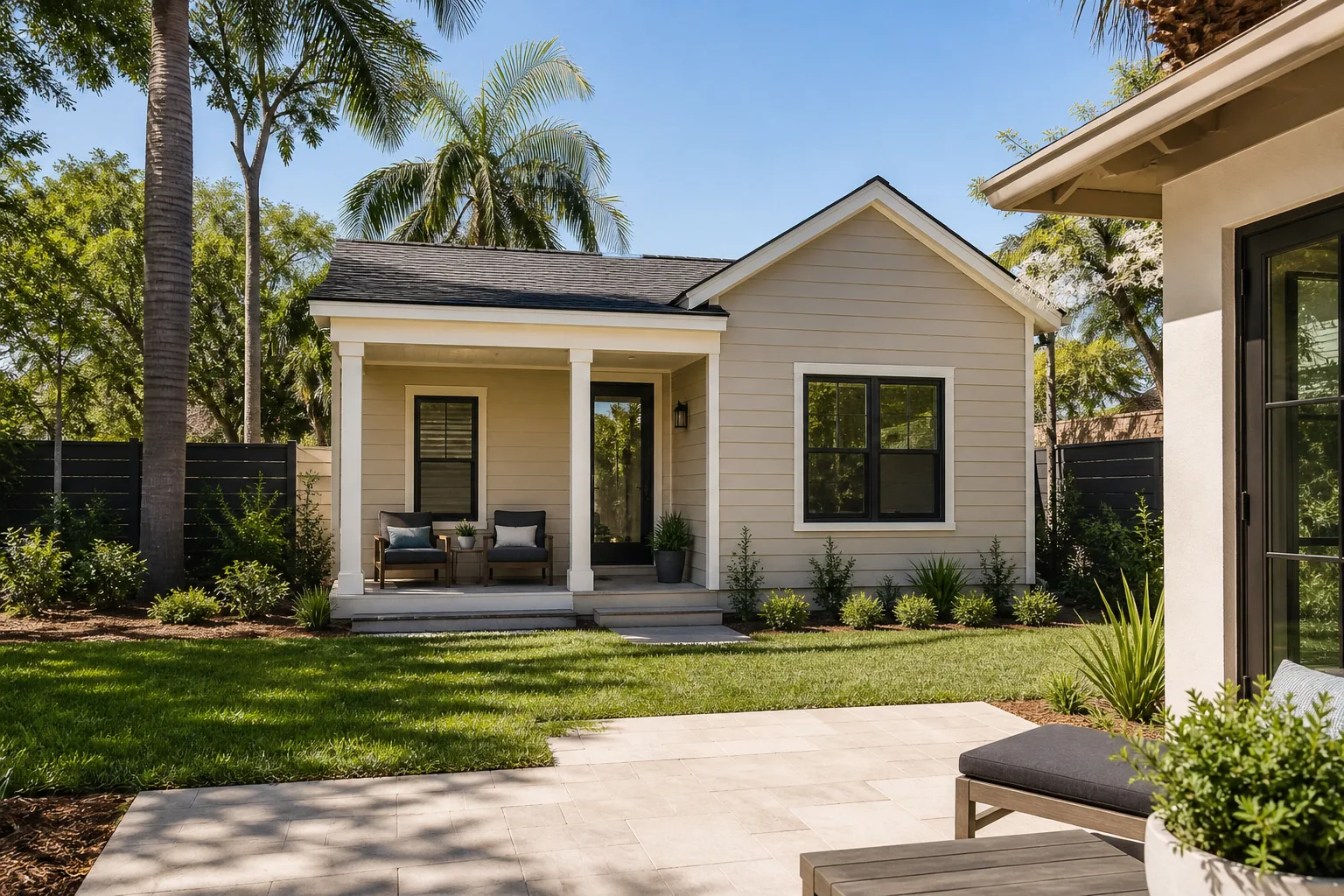
A detached ADU in Glendale typically runs $180,000 to $350,000 depending on foundation type, panel upgrade needs, utility trenching distance, and whether the lot is a flat parcel or a hillside lot. The biggest single driver is site work: a hillside lot with retaining and drainage design can add $30,000 to $75,000 to the same box. Ask for a line-item bid that separates the structure from the site work, and call (844) 320-5930 for a written price before you sign anything.
It shouldn’t, if the scope is written clearly and the contractor carried the right contingencies. The price changes when the bid was vague – “standard slab,” “electrical if needed,” no soils report. Under Clause 1 of the Haven Standard, no work proceeds on a change until the change order is signed, which is why our projects have stayed within a few percent of the agreed price. Call (844) 320-5930 and we’ll review your existing estimate line by line at no charge.
Yes – additions and ADUs in Glendale require building, electrical, plumbing, and mechanical permits, and the contractor on the permit should be a licensed general contractor, not you as owner-builder. Pulling permits is the contractor’s job; verify yours by looking up the permit application number in Glendale’s online portal before work starts. Call (844) 320-5930 if you want a free review of what your contract says about permitting.
A typical single-story addition in Glendale takes 6 to 10 months from permit issuance to final inspection, and an ADU can run 8 to 12 months if utility trenching and Title 24 compliance review add cycles. The schedule should list milestone dates, not “approximately.” A written schedule with inspection dates is standard on our projects.
An ADU (accessory dwelling unit) is a legally separate, self-contained residence with its own kitchen, bathroom, and entrance, permitted as its own dwelling. An in-law suite is a smaller attached unit that may share some systems with the main house and is sometimes permitted only as a “guest house” or “recreation room.” The difference matters at the permit counter and at resale – and it’s worth confirming which one your contractor is actually building before demolition starts.
Look up the license on the Contractors State License Board site (cslb.ca.gov), confirm the classification is B-General Building Contractor, and call the insurance carrier directly to confirm the general liability and workers’ comp certificates are current. Then pull their Glendale permit history from the city’s portal. If any of those three checks come back thin, don’t sign. For related exterior work like fence and driveway surfaces, our Fence Installation in Glendale and Driveway & Pavers in Glendale pages show the same documentation standard applied to smaller projects.
The Bottom Line
The contractors who cause expensive ADU and addition failures tell you who they are at the bid stage. No structural engineer named. No foundation spec. No milestone dates. Payment on a calendar, not on inspection. If those documents are thin, the project will be expensive – and in Glendale, hillsides, older housing stock, and Title 24 compliance make the cost of a vague bid higher than it would be on a flat-lot new build elsewhere. Verify the license, insurance, and permit history in 15 minutes. Ask for a line-item scope. Refuse to be the owner-builder on a project you aren’t building. Every visit includes a documented photo record, background-checked and uniformed technicians, and a live person answering calls. If you already have a written estimate and want a free second opinion, call (844) 320-5930 or start at our Rowan Construction Group Glendale home.
Written by the team at Rowan Construction Group Glendale.