Last updated November 16, 2026
Free written scope consultation - allowances, timeline, and change-order rules on paper before a single trade is scheduled
How Long Does Driveway & Pavers Take? Timelines and What to Expect
Ask three neighbors how long their driveway took and you’ll get three answers, none of them wrong: “Five days,” “Six weeks,” “The whole summer.” Each is measuring a different clock. The physical installation of a paved driveway in Glendale is genuinely a 3-to-5-day job for a standard two-car apron. The project from signed contract to first vehicle on the surface runs 4 to 10 weeks, because permits, material lead times, and cure windows eat the calendar between work days. This guide separates those two timelines, walks each phase with real day counts, and shows you which delays are legitimate and which are a contractor losing interest.
Quick Answer
A standard driveway paver installation takes 3 to 5 working days of actual construction, but the full project timeline from signed contract to drive-ready surface is typically 4 to 10 weeks once permit submittal (5 to 10 business days through the City of Glendale), material lead times, and cure periods are counted. Polymeric joint sand needs 24 hours before foot traffic and 72 hours before vehicle traffic, though Glendale’s June marine layer can stretch that to 96 hours or more. The installation window is predictable. The gaps between phases are where schedules slip.
Table of Contents
- The Two Clocks: Physical Installation vs. Total Project Timeline
- Phase-by-Phase Breakdown with Realistic Day Counts
- How Long Do Permits Take in Glendale?
- Material Lead Times: Belgard and Techo-Bloc Stock vs. Special Order
- What Adds Days: Size, Slope, and Pattern Complexity
- Cure Periods, Compaction Settling, and the 90-Day Window
- Legitimate Delays vs. Contractor Scheduling Problems
- Questions to Put in Writing Before You Sign
The Two Clocks: Physical Installation vs. Total Project Timeline
Most homeowners plan for the first clock and get blindsided by the second. It’s the single most common scheduling mistake we see on paver jobs in Glendale, and it’s avoidable once you know what you’re actually scheduling.
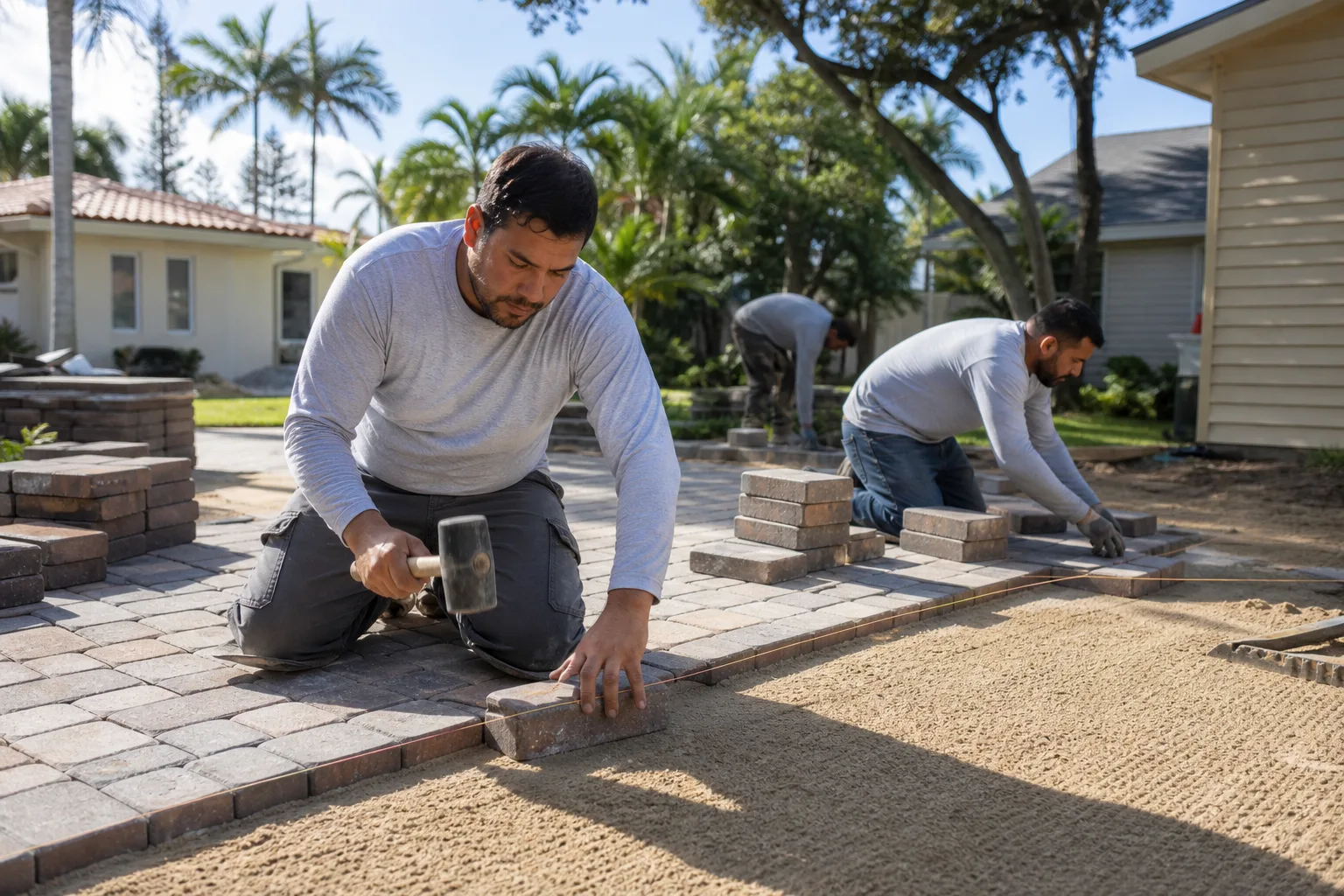
The physical installation window is the work itself: excavation, base prep, setting sand, laying pavers, cutting, joint sand, cleanup. For a typical 400-to-600-square-foot driveway with a curved apron and border course, that’s 3 to 5 working days with a full crew. Straightforward, predictable, and the number a good contractor quotes you first.
The total project clock runs from signed contract to first vehicle on the surface, and it looks nothing like the installation number:
- Contract to permit submittal: 1 to 3 business days
- Permit review through City of Glendale: 5 to 10 business days (longer if the driveway intersects a zone requiring plan check or excavation within the right-of-way)
- Material lead time: 3 to 7 days for Belgard stock colors; 2 to 4 weeks for Techo-Bloc special orders or non-stock blends
- Installation: 3 to 5 working days
- Joint sand cure and vehicle cure: 3 to 4 days total, occasionally longer in coastal-moisture months
The math puts a clean project at roughly 4 to 6 weeks. Add a special-order paver blend and a permit hold and it runs 8 to 10. We’ve seen homeowners budget only the five installation days and schedule their old driveway demolition for the same week the contract was signed. That’s how a project drags: the schedule was never realistic to begin with.
If you’re ready to lock down an actual calendar instead of a guess, our team publishes written timelines with every quote. See Driveway & Pavers in Glendale for the complete scope and service details.
Phase-by-Phase Breakdown with Realistic Day Counts
Here’s what each phase involves and how long it actually takes on a Glendale paver driveway, from the site visit through the final walk. The day counts assume a full crew and no surprises. Surprises get their own section further down.
- Site visit and written quote (1 to 2 business days): We measure the footprint, check the existing surface and subbase, look at slope and drainage, and photograph the conditions. You receive a flat written price with a written scope and a written warranty before any work starts. No verbal estimates, no “we’ll figure it out on demo day.”
- Permit submittal (5 to 10 business days for review): Driveways in Glendale fall under permit review, and any work affecting the curb, apron, or right-of-way adds steps. Submittal happens within a few business days of signing. The review window is set by the city, not by the contractor.
- Material delivery (3 to 7 days stock, 2 to 4 weeks special order): Stock Belgard colors in common blends move quickly from regional distribution. Techo-Bloc or non-standard blends, matching borders, and dimensional stone accents need to be ordered. Material sits on-site before excavation starts, not during.
- Excavation (1 day): Removal of the old surface and enough subgrade to accept the base layer. This is the day the crew learns what’s actually under your driveway. Tree roots, old concrete slabs, abandoned irrigation lines, buried utility stubs from a 1950s-era tract home. What they find sometimes adds half a day.
- Base installation and compaction (1 to 2 days): The base is the part nobody sees and the part that determines whether the driveway lasts. Class II aggregate, moisture-conditioned and compacted in lifts, checked for slope and drainage. A 4-inch base on a passenger-car driveway; 6 to 8 inches where trucks or RVs park.
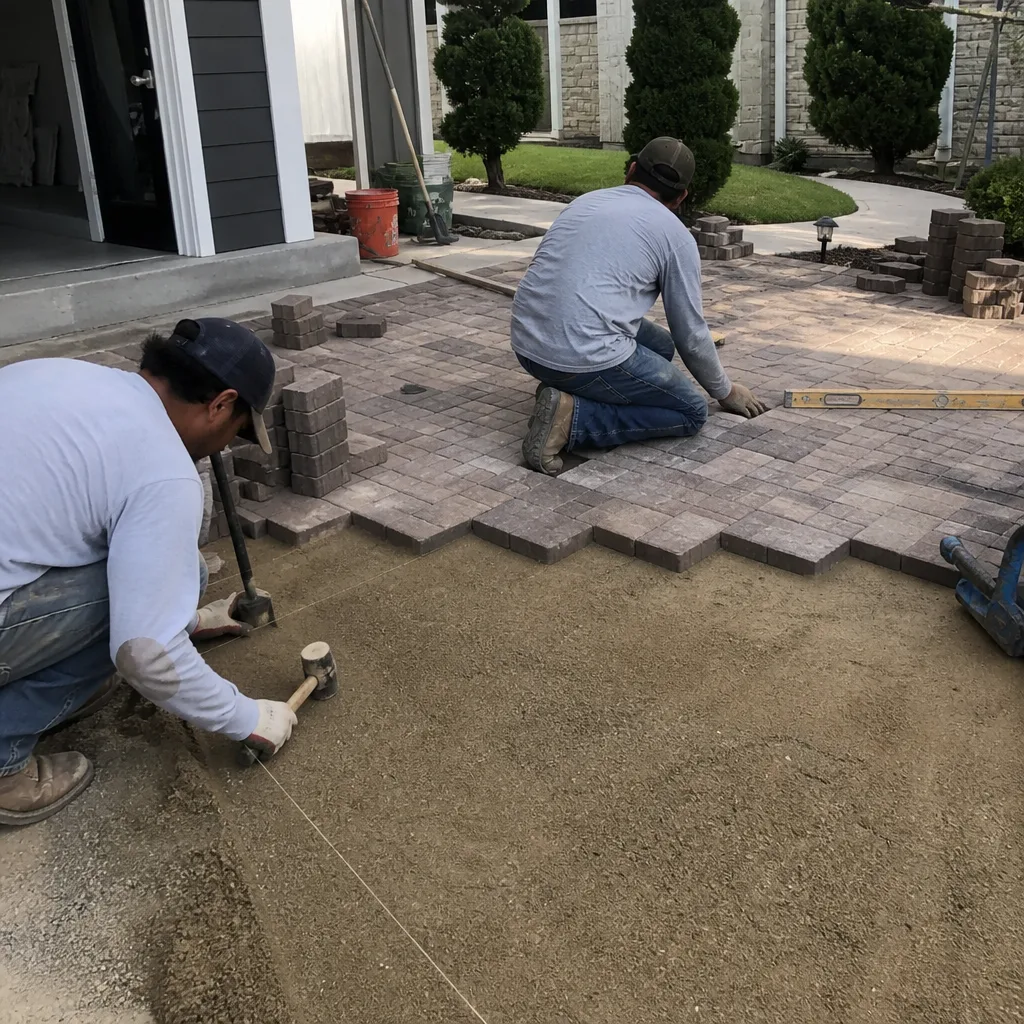
- Setting bed and paver laying (1 to 2 days): A 1-inch bed of bedding sand screeded to grade, then the pavers laid in pattern. Running bond on a flat straight driveway moves fast. Herringbone, basketweave, curved bands, and sloped lots do not.
- Edge restraint, cutting, and polymeric joint sand (1 day): Edge restraint anchored on both sides, cuts made at borders and corners, then polymeric sand swept into the joints.
- Cure and final walk (3 to 4 days): Joint sand needs 24 hours dry before foot traffic and 72 hours before vehicle traffic. We do a documented final walk, hand over the photo record, and file the warranty.
Sum the on-site days and you’re at 4 to 5 working days of construction. The whole project lives in the gaps between them. That’s not padding. That’s what the city review board and the material distributor actually control.
How Long Do Permits Take in Glendale?
Permit review for a residential driveway in Glendale typically runs 5 to 10 business days for a straightforward replacement with no curb or right-of-way changes. Anything that touches the apron, the sidewalk, or the area within the public right-of-way goes through additional review steps, which adds a week or two. Plan on the longer end if your driveway opens onto a busy collector street or intersects a corner where sight-distance rules apply.
What that means in practice: the permit clock starts when the complete submittal goes in, not the day you signed. A contractor who waits a week to submit eats a week of your schedule before the city has even opened the file.
Two things to confirm in writing before you sign:
- Who submits and who pays. Rowan pulls permits as part of the written scope. Some contractors pass the permit fee through after the fact, which defeats the point of a flat written price.
- The submittal date. “We’ll get it in next week” is not a date. A written schedule names the day the submittal goes in.
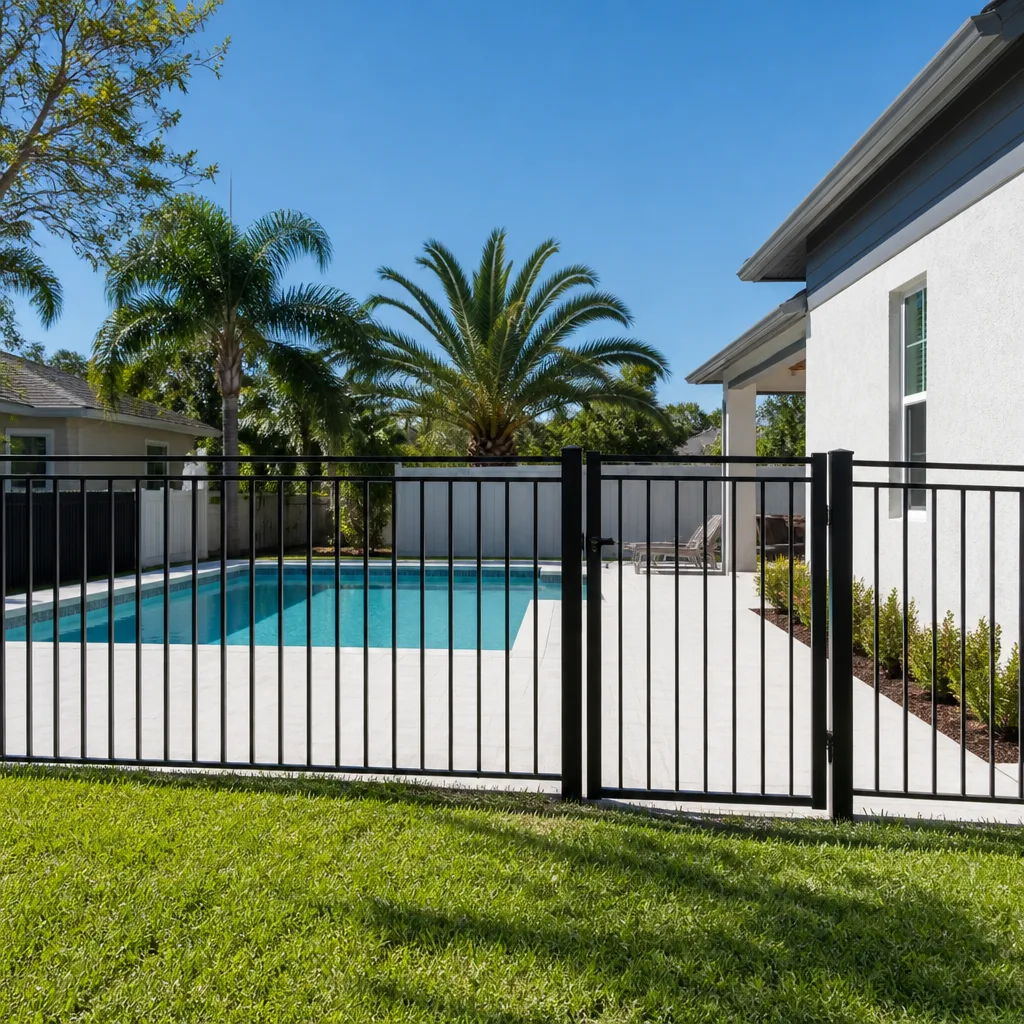
This is also the phase where a poor fit between the driveway and the rest of the property shows up. If your project is part of a larger backyard rebuild, coordinating the paver scope with Fence Installation in Glendale saves a second round of excavation and a second permit cycle in the same yard.
Material Lead Times: Belgard and Techo-Bloc Stock vs. Special Order
Material lead time is the single most variable stretch of the total project clock, and it’s the one you can fully control before signing. The difference between a 5-week project and an 8-week project is often just whether the paver you fell in love with is a stock color or a special order.
As a rule, and naming the brands we use most:
- Belgard stock colors and blends from the common product lines typically move in 3 to 7 days from regional distribution. This is the fastest path and the one to choose if the calendar matters.
- Techo-Bloc special orders and non-stock blends run 2 to 4 weeks depending on the product family and factory scheduling. Worth the wait for the right look, but it must be on the schedule from day one.
- Matching cap and accent pieces, custom border courses, and dimensional cut stone add another 1 to 2 weeks if they’re coming from a different run than the field pavers.
The mistake we watch for: a homeowner picks a beautiful Techo-Bloc blend from a photo, signs the contract, and then expects the crew on-site in 10 days. The pavers haven’t been manufactured yet. Nothing is wrong. The plan just never matched the material.
Rowan sources across fifty-plus vetted brands. That’s not a marketing line; it’s how we give you a written price that holds up. When we write the quote we confirm the actual lead time for the actual product on the actual order, and the schedule reflects it. If a special-order blend would blow your timeline, we say so before you sign and price a stock alternative on the same page so you can compare in dollars.
What Adds Days: Size, Slope, and Pattern Complexity
The installation window is not one number. It flexes with three factors that a written scope should name and a written schedule should account for.
Project size. A 300-square-foot single-car apron is one to two days of setting. A 900-square-foot driveway with a turnaround runs the crew three to four days on the pavers alone before you count excavation and base.
Slope. Glendale’s hillside neighborhoods, the canyon streets off Chevy Chase and the grade changes above Glenoaks, mean driveways that fall more steeply than a flat lot. Steeper grades need deeper base, more compaction lifts, and more cutting on the pavers themselves. A sloped driveway also needs a drainage plan that a flat lot doesn’t, which can add a half day of trenching and setting outlets or a channel drain at the apron.
Pattern. This is the one homeowners consistently underestimate. A herringbone pattern on a sloped driveway adds 20 to 30 percent labor time over a running bond on a flat lot. The reason is simple: herringbone wastes more material on cuts and asks the crew to place every stone at an angle, which is slower. Running bond on a straight flat driveway moves at roughly double the pace. Basketweave, curved bands, and multi-color patterns sit between. If your design calls for herringbone with a contrasting border on a slope, budget the extra time. It’s real.
Here’s the rule of thumb: on a flat Glendale lot in running bond with stock Belgard pavers, the installation is the 3-to-5-day number. Change the pattern to herringbone, add a slope, or up the size, and you should be planning 5 to 7 working days of construction, sometimes 8.
Cure Periods, Compaction Settling, and the 90-Day Window
Polymeric joint sand is the phase that catches everyone. The sand activates with water and cures to lock the pavers together, and the cure is weather-dependent. Twenty-four hours dry before foot traffic. Seventy-two hours dry before vehicle traffic. In the dry heat of a Glendale September, that’s the floor. In the June marine layer, when the morning damp burns off late and the humidity sits high, we’ve watched the same sand take 96 hours or more before we could recommend driving on it. No reputable contractor can promise a date certain on the joint sand without checking the forecast the week of install.
That short cure is only the first part. The pavers and base settle as a system over the first season of use. We ask homeowners to expect:
- First 30 days: Normal hairline settling as the base compacts under traffic. Nothing to fix.
- 90-day window: This is when we walk the driveway against the joint sand performance. If a low spot has developed or a joint is washing out, that’s the point of inspection under our 365-Day Done Right Promise. If it isn’t right, we make it right, backed by the Haven Standard, not a handshake.
- Re-sanding: A light top-up of polymeric sand in the first year is common and normal. It’s also something our written warranty describes in plain terms so it isn’t a surprise.
One thing to protect during the settling window: don’t steer a loaded truck or a heavy utility trailer onto the surface for the first month, and re-sand before the first rainy season if you’re going to drive on it year-round. Aggressive turning and spin-out at the apron are the most common cause of early joint wash-out we see.
Legitimate Delays vs. Contractor Scheduling Problems
There is a real difference between a delay caused by something outside anyone’s control and a delay caused by the contractor. The first you plan around. The second is a document problem.
Legitimate delays
- Permit holds. The city comes back with a request for a revision, a sight-distance detail, or drainage documentation. The clock stops and restarts. Normal and out of the contractor’s hands.
- Material back orders. A factory run is delayed, a color is temporarily out of stock, the special-order shipment arrives a week late. Uncomfortable but real.
- Weather windows. Rain in the forecast during excavation or joint sand is a genuine reason to pause. Setting pavers on a saturated base or activating polymeric sand before a rain event is a guarantee of a problem. The pause is the doing-it-right move.
- Site surprises. An unmarked utility line, a buried slab, or a root system that needs removal before base prep. Surprises get photographed and priced in writing before the scope changes, per the Haven Standard.
Scheduling problems that aren’t
- “We got busy.” Your job has a crew assigned or it doesn’t. Busy is a scheduler telling you they overbooked.
- “The crew is finishing another job.” Every contractor with a full calendar has other jobs. The schedule either accounts for that or it doesn’t.
- “We’ll pick up where we left off next week.” A five-day job broken into two weeks of on-and-off visits is a scheduling failure dressed as logistics. The classic tells: crews showing up for half days, gaps in the sequence with the driveway left open and unstabilized, and no written notification of the change.
- No written change order. Under Clause 1 of the Haven Standard, no work proceeds on a change until the change order is signed. If the crew is talking about more money mid-project and nothing’s on paper, stop.
Under our 365-Day Done Right Promise, if something isn’t right, we make it right. That’s a different commitment than hitting a date. Nobody controls the city review board or a factory run. Everybody controls whether you were told, in writing, what the plan was and what changed.
Questions to Put in Writing Before You Sign
The best defense against a slipping schedule is a written timeline you can hold a contractor to. Before you sign anything, put these questions in writing and require a written answer:
- What’s the confirmed material lead time for my specific paver, in business days, from order to on-site? Not a range for the product line. The actual order.
- What’s the permit submittal date, in days from contract signing? Then ask who submits and who pays.
- What’s the written weather delay policy? What triggers a pause, who decides, and how is it communicated?
- What triggers a schedule change notification, and how will I get it? Text, email, call. In writing.
- What happens if the material is delayed or a permit is held? The schedule either accounts for the delay or it doesn’t. Get the answer down.
- What’s the written joint sand cure window, and how is the forecast factored in? If someone promises a specific drive-ready date without mentioning weather, that’s a red flag.
- What does the final walk look like, and will I get the photo record? Our visits include a documented photo record as a standard deliverable, not an add-on.
Rowan pricing is flat and written before any work starts. No verbal estimates, no “we’ll finalize the number later.” The quote you sign is the price you pay, and the schedule is written on the same page. If you want a free second opinion, bring a competitor’s written estimate and we’ll review it line by line at no charge.
For the whole scope, from the first site visit through the finished surface, see the Rowan Construction Group Glendale home page. Ready to price your project? Call (844) 320-5930 for a free estimate and a written timeline tied to your actual pavers.
Common Mistakes to Avoid
- Planning around the installation window and forgetting the total clock. Five days of install is not a five-day project. Plan 4 to 10 weeks from signed contract to first vehicle on the surface, and don’t schedule demo until the pavers are on-site.
- Picking a non-stock special-order blend without checking the lead time. A Techo-Bloc special order can add 2 to 4 weeks over a stock Belgard blend. Know which one you’re buying before you sign, not after.
- Skipping the weather check on the joint sand window. A June marine layer in Glendale can push the 72-hour vehicle cure to 96 hours or longer. No reputable contractor gets a date certain here without the forecast.
- Starting demo before the permit is approved. Pulling the old surface early just leaves a torn-up yard waiting for review. It doesn’t save time; it costs you a temporary parking headache.
- Choosing herringbone with a contrast border on a sloped driveway without accounting for labor. That combination adds 20 to 30 percent to the installation time over running bond on a flat lot. It’s worth it for the look, just budget it.
- Settling for a verbal schedule. A contractor who won’t put submittal dates, material lead times, and a weather delay policy in writing hasn’t committed to a schedule. Verbal promises evaporate the day the crew is late.
- Driving on the driveway before the joint sand cures. Aggressive turning and spin-out at the apron are the most common cause of early joint wash-out. Keep the truck off for the full cure window, not just the first day.
Styles & brands we work with
- Kitchen remodeling
- Bathroom remodeling
- Home additions & ADU
- Roofing
- Windows & doors
- Driveway & pavers
- Fence
When to Call a Professional
Call a professional before you do any of the following: excavating by hand to “see what’s under there,” cutting the existing driveway out ahead of the permit, laying pavers on top of an existing surface as a shortcut, or trying to source and schedule a special-order paver blend yourself. Paver work looks approachable on video. The base and the compaction are what make it last, and those are where shortcuts get expensive fast. If your driveway is sloped, drains toward the house, or opens onto a busy Glendale street, the drainage and right-of-way details are a professional’s problem, not a weekend’s.
If you’re coordinating a driveway with a fence, a backyard rebuild, or an addition, call us before the first shovel’s in the ground. Rowan Construction Group Glendale offers free estimates in Glendale. Call (844) 320-5930 and we’ll put a written scope, a flat price, and a schedule in front of you before any work begins. You’ll also get a documented photo record on every visit and a written warranty, and background-checked technicians show up in uniform.
Frequently Asked Questions
The physical installation takes 3 to 5 working days for a standard two-car driveway in Glendale. The full project from signed contract to first vehicle on the surface runs 4 to 10 weeks once permit review, material lead times, and cure periods are counted. Call (844) 320-5930 for an exact quote and a written timeline for your project.
Permit review for a residential driveway in Glendale typically runs 5 to 10 business days for a straightforward replacement with no curb or right-of-way changes. If your project touches the apron, the sidewalk, or the public right-of-way, additional review steps can add a week or two. Confirm in writing who submits the permit and when the submittal goes in. Call (844) 320-5930 for a written schedule tied to your actual site.
No. Polymeric joint sand needs 24 hours dry before foot traffic and 72 hours before vehicle traffic. In Glendale’s coastal-moisture months, especially the June marine layer, that vehicle cure can stretch to 96 hours or more. Drive-ready date depends on the forecast, and no reputable contractor promises a date certain without checking it. Call (844) 320-5930 for a written cure window in your quote.
The biggest time-adder is a special-order paver blend, which adds 2 to 4 weeks over stock Belgard colors. After that, permit holds and pattern complexity. A herringbone pattern on a sloped driveway adds 20 to 30 percent labor time over running bond on a flat lot. Know which factors apply to you before you sign. Call (844) 320-5930 for a line-item review.
No. Rowan quotes a flat written price with a written scope before any work begins, and the price on the quote is the price you pay. If site conditions require a change, no work proceeds on that change until the change order is signed, per Clause 1 of the Haven Standard. That’s the discipline that keeps projects within a few percent of the agreed cost. Call (844) 320-5930 for a written price and a free second opinion on any competitor’s estimate.
It’s normal for pavers and base to settle slightly over the first season of use, and the 90-day window is when we walk the surface against the joint sand performance to confirm everything is behaving as it should. Minor joint top-up in the first year is common and covered in the written warranty. If something isn’t right, our 365-Day Done Right Promise means we make it right. Call (844) 320-5930 to schedule a walkthrough.
Written by the team at Rowan Construction Group Glendale.
See the difference
 Before
 After
 Before
 After
 Before
 After